


Tree of Life

The Sephirotic Map of Creation

A map of how the infinite reaches matter, and the way back — mercy and severity held in balance.


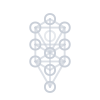
In Jewish Mysticism (Kabbalah), the Tree of Life is the central mystical symbol. It consists of ten spheres, known as Sephirot, connected by twenty-two paths. It maps the process by which the infinite, unknowable Divine (Ein Sof) emanated the universe into existence, stepping down energy from pure crown consciousness (Keter) to physical reality (Malkhut). It is both a macrocosmic blueprint of the universe and a microcosmic map of the human soul, outlining the spiritual path of return to divine unity through the balance of mercy and severity.

Light

Facilitates a profound understanding of life's multidimensional nature, spiritual ascension, and the harmonization of intellect and emotion.

Shadow

Getting lost in esoteric complexity, over-intellectualizing spirituality, or becoming detached from grounding physical realities.


Sources and verification6 links

No formal citations for this entry yet. The reading above carries its own attribution.

Linked entries

  • Received fromThe Emerald TabletA modern connection

    Eliphas Levi, writing in 1854-56, joined the Tablet's doctrine of correspondence to the Kabbalistic tree and the tarot; that pairing is his, not medieval.

  • Received fromThe ZoharAttested

    The sefirotic symbolism the Zohar elaborates is the doctrine the familiar ten-circle diagram renders, but J. H. Chajes (2022) dates such diagrams from the fourteenth century onward and shows their layouts varied widely — the picture is later than the book, and was never fixed.

  • Corrected bySefer YetzirahAttested

    The word sefirot and the count of ten come from Sefer Yetzirah; the diagram does not. J. H. Chajes dates the ten-circle tree to the fourteenth century onward, and the tarot and path correspondences drawn on it to Mathers in 1887.

  • Often confused withPseudo-Dionysius the AreopagiteA modern connection

    Agrippa's De occulta philosophia (III.10, Cologne 1533; Englished in 1651 as Three Books of Occult Philosophy) sets an angelic order beside each of the ten sephiroth, using the Dionysian nine and adding a tenth rank of blessed souls - a Renaissance Christian-Kabbalist fusion of two schemes with separate origins.

  • Received fromHeinrich Cornelius AgrippaAttested

    Book III sets out the ten Sephiroth for readers with no Hebrew, rendering them as "numerations" and pairing each with a divine name and an angelic order - one of the main channels by which the Kabbalistic scheme entered non-Jewish European magic.

  • IncludesShekhinahAttested

    She is Malkhut, the tenth and lowest rung, at the foot of the Tree — the sefirah that receives from all nine above and has nothing of its own. Matt's Pritzker diagram lists her names there: Presence, Assembly of Israel, Earth, Moon, Queen, Apple Orchard, King David, Rachel.