

Ankh
The Breath of Life
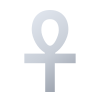
The Egyptian hieroglyph for 'life', a looped cross the gods hold to the king's nose to give him breath.
The ankh is the Egyptian sign for 'life', a triliteral hieroglyph writing the three consonants of that word, catalogued by Gardiner as S34. Early examples date to the First Dynasty, around the thirtieth century BC. What object it depicted is unknown: many scholars read it as a knot tied in cloth or reeds, close in form to the tyet, while Gardiner proposed a sandal strap borrowed for its sound. Both are proposals, though popular accounts repeat them as settled. In tomb and temple art the gods hold the ankh to the nose of the king, giving the breath of life, often beside the was sceptre and djed pillar: life, dominion, stability. Egyptian Christians later adapted it into the crux ansata, attested from the third or early fourth century AD.
Light
Stands for life as something given and continually renewed: breath, water, health, and the survival of the person after death. Held out by a god, it is a blessing extended through the king to a whole country.
Shadow
Before the end of the Middle Kingdom, anyone other than the king was rarely shown holding or receiving it: life pictured as flowing from the gods through the throne and seldom into other hands. Detached from the language it belongs to, the shape is easily reproduced without the word it writes.