



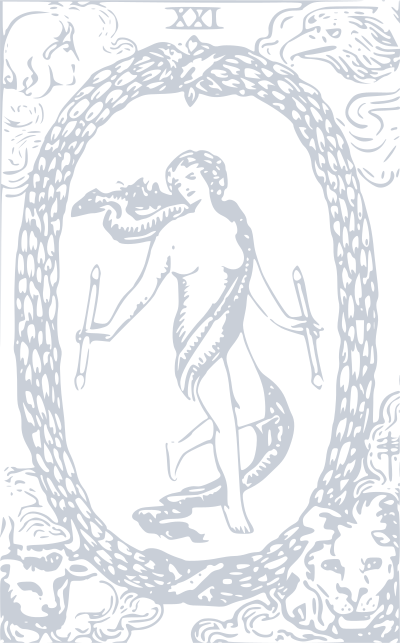
Illustration by Pamela Colman Smith, 1910. Public domain in the US since 1966 and in the UK since 2021. Vector digitisation of the Rider–Waite–Smith deck by OpenClipart contributor "klaatu-tarot", released public domain.
The World
Divine Vision and the Restored World
In 1911 Waite rejected identifying the World's figure as a magician at the highest initiation, calling it one of the worst explanations.
A. E. Waite, The Pictorial Key to the Tarot (1911 edition), Part II, XXI, The World; part III, section 3, XXI.
A dancer holds two wands within a wreath, with a human head, eagle, lion and bull at its corners.
More context
Waite reads the World as the cosmos's perfection and its understanding of itself in God. It is also the soul's consciousness of divine vision. He associates it with a restored world and with creation's original declaration of goodness. He rejects the claim that the figure represents a magician reaching the highest degree of initiation, and also rejects its identification with the absolute. His divinatory meanings include assured success, reward and travel. The account does not construct a cycle in which the Fool steps out of the wreath.
Light
Waite gives cosmic perfection, divine vision and the restored world; practical meanings include assured success and recompense.
Shadow
Waite’s reversed meanings are inertia, fixity, stagnation and permanence.