



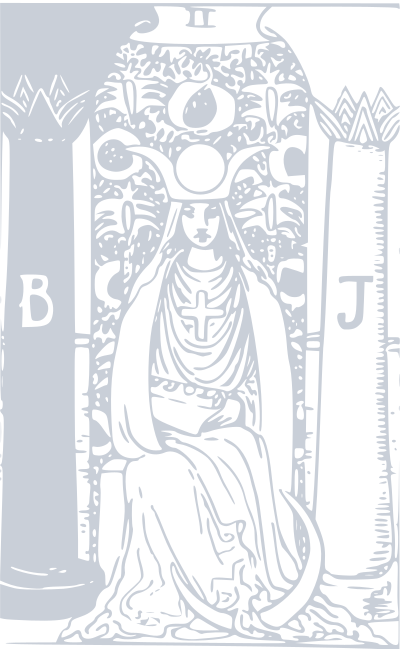
Illustration by Pamela Colman Smith, 1910. Public domain in the US since 1966 and in the UK since 2021. Vector digitisation of the Rider–Waite–Smith deck by OpenClipart contributor "klaatu-tarot", released public domain.
The High Priestess
Intuition, Mystery, Subconscious
Waite's 1911 key gives her older names, Pope Joan or Female Pontiff, and rejects the early title Pope's Wife as opposed to the symbolism.
A. E. Waite, The Pictorial Key to the Tarot (1911), Part I §2, card 2
A woman in blue sits between black and white pillars, a scroll marked Tora half hidden in her mantle.
More context
In Pamela Colman Smith's design for Waite's 1910 deck, the High Priestess wears a horned diadem with a globe. A solar cross is on her breast and a lunar crescent at her feet. She sits between the white and black pillars marked J. and B., before a veil embroidered with palms and pomegranates. Her scroll reads Tora and is partly covered by her mantle. Waite, in The Pictorial Key to the Tarot (1911), calls her the Secret Church and gives her highest name as the Shekinah, the co-habiting glory. He calls the card in some respects the highest and holiest of the Greater Arcana.
Light
Waite's divinatory meanings: secrets, mystery, the future as yet unrevealed; silence and tenacity; wisdom and science.
Shadow
Reversed, Waite reads passion, moral or physical ardour, conceit and surface knowledge.