



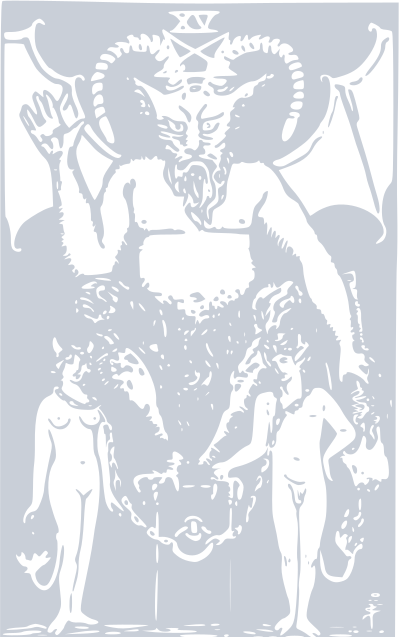
Illustration by Pamela Colman Smith, 1910. Public domain in the US since 1966 and in the UK since 2021. Vector digitisation of the Rider–Waite–Smith deck by OpenClipart contributor "klaatu-tarot", released public domain.
The Devil
Material Bondage and Animal Nature
Waite's 1911 Devil is himself a bondsman and will not rule forever: his explanation does not reduce the human pair's bondage to their voluntary consent.
A. E. Waite, The Pictorial Key to the Tarot (1911 edition), Part II, XV, The Devil; part III, section 3, XV.
A horned, winged figure holds a downward torch above two naked figures chained to its altar.
More context
Waite places two tailed human figures beneath a winged, horned figure, chained at their necks to its altar. He connects the scene with Adam and Eve after the Fall and the fatality of material life. Their tails signify animal nature, while their faces retain human intelligence. The elevated figure will not master them forever; he too is a bondsman, sustained by his own evil. Waite does not make the chains' loose appearance his entire interpretation or state that daily consent accounts for all bondage.
Light
Waite says the elevated figure will not master the human pair forever; their faces retain human intelligence.
Shadow
Waite connects the chains with material life’s fatality and the tails with animal nature; the elevated figure is himself bound.