



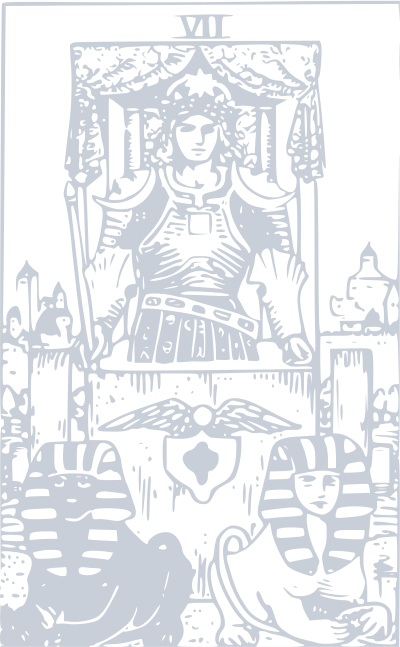
Illustration by Pamela Colman Smith, 1910. Public domain in the US since 1966 and in the UK since 2021. Vector digitisation of the Rider–Waite–Smith deck by OpenClipart contributor "klaatu-tarot", released public domain.
The Chariot
Triumph and Its Limits
Waite stated in 1911 that the Chariot's conquests were external, not within himself: the source explicitly limits the inner-mastery reading now commonly attached to it.
A. E. Waite, The Pictorial Key to the Tarot (1911 edition), Part II, VII, The Chariot; part III, section 3, VII.
A crowned figure stands in a canopied chariot before black and white sphinxes.
More context
Waite calls the charioteer triumphant in mind, science, progress and certain initiatory trials. He accepts the two sphinxes through Éliphas Lévi's variation of the design. The victory has limits: its planes are external, not conquest within the hero himself. Rational understanding may remain a bondage, and the hero cannot answer the High Priestess's spiritual question. The divinatory list also includes war, presumption and vengeance. This is not an assurance of complete inner mastery, nor an explanation that attention alone drives opposite-pulling animals.
Light
Waite gives triumph in mind, science, progress and certain trials of initiation.
Shadow
Waite warns that external conquest may leave the charioteer bound to rational understanding and unable to answer spiritual questions.