



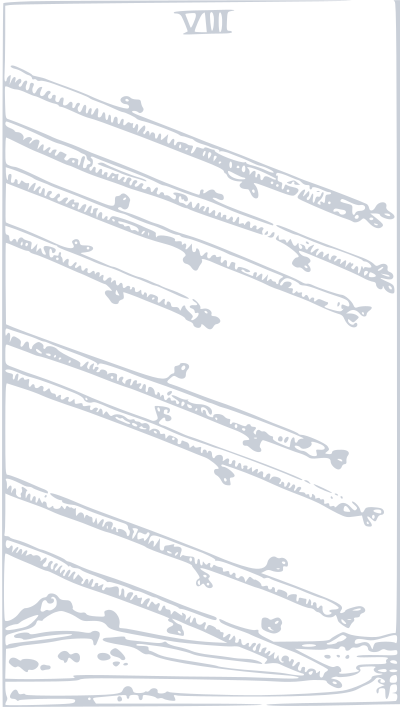
Illustration by Pamela Colman Smith, 1910. Public domain in the US since 1966 and in the UK since 2021. Vector digitisation of the Rider–Waite–Smith deck by OpenClipart contributor "klaatu-tarot", released public domain.
Eight of Wands
Swift action, rapid communication, and unhindered movement.
Waite's 1911 entry includes the arrows of love among upright meanings, then turns them into arrows of jealousy when reversed.
A. E. Waite, The Pictorial Key to the Tarot (1911 edition), part III, section 2, Eight of Wands, upright and reversed meanings.
Eight staves fly through the air over open country, with no figure in the picture.
More context
Waite describes eight wands flying over open country, nearing the end of their course. Their arrival is imminent. His divinatory meanings include activity in undertakings, swiftness like an express messenger, haste, hope and movement towards a favourable conclusion. He also includes the arrows of love. The reversed card turns those arrows into jealousy and names quarrels, internal dispute and domestic disputes. The image has no human figure, but includes a distant building. Waite does not explain it through Hod or an interval that belongs to nobody.
Light
Waite gives swiftness, great hope and movement towards a happy conclusion; he also includes the arrows of love.
Shadow
Waite's reversed meanings include jealousy, internal dispute, quarrels and domestic disagreements.