


Orthodox Cross
Three Bars, Eight Ends
The slanted footrest, read in later piety as mercy at the last hour — or as a verdict already passed.
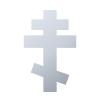
Three bars distinguish it. The topmost is the titulus, the board Pilate ordered fixed above Christ; the middle is the crossbeam that bore the arms; the lowest is the suppedaneum, or footrest. Counting its eight ends, Russian tradition calls it the eight-pointed cross. The footrest is old, appearing in Eastern crucifixion imagery from around the sixth century, but earlier Byzantine work generally drew it level, and Greek depictions commonly still do. The slant belongs to Russian and other Slavic usage, and the readings given for it — a balance-beam of righteousness, or a bar raised towards the penitent thief and lowered towards the impenitent — are pious interpretations of later date, not an account of how the cross was made.
Light
Signifies mercy still available at the last hour, endurance rather than escape, and an unbroken line of worship carried from Byzantium into the Slavic churches, standing over domes, doorways and graves.
Shadow
The slant can be read as a verdict already delivered, sorting people into saved and damned, which inverts the penitent thief it points to. The shape itself became a badge of party in the Russian schism of the 1650s.